
Spirituality
Spiritual revelations do not arrive from thinking long & hard about Divinity. They come through silencing our thoughts, moving our ego out of the way, and opening up to the quiet, mysterious, spiritual realm that is always here with us. The world of soul is here and now, superimposed and woven through the world of the five sense. It doesn't take belief. It is Reality itself. You must only learn to see beyond the veils.
“There is another world, but it is in this one."
–W.B. Yeats
Spirituality
Spiritual revelations do not arrive from thinking long & hard about Divinity. They come through silencing our thoughts, moving our ego out of the way, and opening up to the quiet, mysterious, spiritual realm that is always here with us. The world of soul is here and now, superimposed and woven through the world of the five sense. It doesn't take belief. It is Reality itself. You must only learn to see beyond the veils.
“There is another world, but it is in this one."
–W.B. Yeats
Spirituality
Spiritual revelations do not arrive from thinking long & hard about Divinity. They come through silencing our thoughts, moving our ego out of the way, and opening up to the quiet, mysterious, spiritual realm that is always here with us. The world of soul is here and now, superimposed and woven through the world of the five sense. It doesn't take belief. It is Reality itself. You must only learn to see beyond the veils.
“There is another world, but it is in this one."
–W.B. Yeats
Healing
Healing occurs in the mind, heart, spirit, and body. Any system of self-improvement that does not address all of these essential components of the human being is lacking. I believe this so strongly I’ll repeat it: Any attempt to heal only one aspect of yourself without addressing the others, will ultimately lead to imbalance and unhappiness.
Hapé Ceremonies


Sacred Ceremonies & Living Traditions
Ceremonies and ritual practices have been part of the human experience for tens of thousands of years. They are no less powerful today than they were when performed by our ancient ancestors beneath the stars. Across cultures and epochs, rites of passage and holy rituals satisfy our longing for spiritual communion, personal and collective healing, and a reverent intimacy with existence itself. To participate in such a ceremony is to step into a lineage of remembrance—to dedicate oneself to the ongoing mystery of becoming.
Over the course of my life, I have worked with a range of entheogens, including ayahuasca, wachuma, peyote, hapé, psilocybin, chiric sanango, and iboga. When approached with integrity and proper guidance, these plant medicines can help you connect to your intuition, heal from past sufferings, refine your perception, dissolve egoic patterns, open your heart, and experience a deepened sense of connection to yourself, to others, and to the living world. After a hapé ceremony, specifically, many people report feeling lighter inside—or they describe a grounded, steady clarity that supports more embodied presence in their lives.
What is Hapé
Hapé—also known as rapé or hapeh—is a legal mixture of dried Amazonian plants, typically sacred tobacco (mapacho) combined with ashes from specific trees, vines, or flowers. Most of the hapé I offer are made with ashes from the bark of the medicinal Tsunu tree, known for its stabilizing and protective properties.
This medicine has long been used by Indigenous peoples across South America within ceremonial, medicinal, and spiritual contexts—as a way of clearing spiritual and energetic burdens, reconnecting with the Earth, cultivating spiritual clarity and balance, and strengthening prayer and inward listening. It is sometimes described as a masculine, benevolent, and wise teacher. Unlike the more fantastical, vision-producing plant medicines, hapé is not a psychedelic.
Being served hapé is a deeply embodied experience; you are unlikely to experience the kind of immersive visionary states associated with psychedelic medicines. Instead, hapé is oriented toward grounding awareness in the physical body in a deeply earthly and present way—though if you naturally have a proclivity toward rich visions and out-of-body experiences, those can still arise.
That said, hapé can work with surprising force. The Yawanawá of Amazonian Brazil regard hapé as a master plant—just as powerful as ayahuasca, though in a different way. They use hapé during ayahuasca ceremonies to restore balance and grounding, and to help participants avoid getting lost internally. They also frequently use hapé on its own.
During a ceremony, it is common to experience sweating, tears, a tingling in the limbs, or purging. Within many Amazonian traditions, these responses are understood as part of a process of cleansing, release, grounding, or spiritual reorientation. Some participants describe becoming aware of emotions, memories, fears, or patterns that feel ready to be relinquished—for instance, self-hate, old attachments, anxiety, doubt, or unresolved emotional pain.
On some occasions, a person may not feel much at all. I've witnessed people sleep through entire ayahuasca ceremonies (while others around them were hanging on for their dear lives.) The same is true with hapé. As a curandero once told me: the medicine meets each person differently.

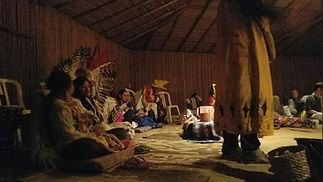






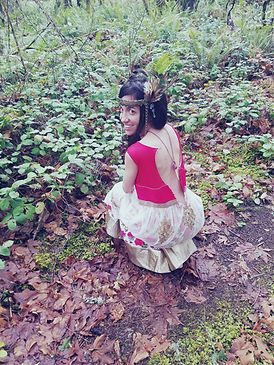


About the Hapé I Carry
If you have never worked with hapé before, welcome. The medicines I carry are legal plant medicine blends prepared by the Yawanawá, Huni Kuni, and Kuntanawa peoples of Amazonian Brazil. Most of these hapés were received directly from the trusted medicine men and women who prepared them, or passed to me through respected friends. Knowing the source is important because, within these traditions, the spirit and energy of the shaman/pajé who prepares the hapé enters the medicine itself and is carried into the person receiving it, as does the energy of the person administering the hapé, the pipe through which it is served, and the energies of the plant spirits themselves.
One of the most humble and powerful pajés I've had the honor of working with is Peu Yawanawá, pictured below on the left (or bottom, if viewing on mobile). The last time I was in Brazil, I brought back a strong supply of Peu's medicine, which I carry with great respect. I also work with a beautiful hapé that carries the spirit of the Kanaro—the blue macaw—revered by the Yawa as a sacred messenger between worlds. This special blend was created by Shaneihu, one of Chief Biraci's sons, pictured below on the right (or top, if viewing on mobile).
The newest hapé I discovered carries the spirit of the Awavãna—the blue moprho butterfly. It was prepared by Hushahu (also pictured below), one of the first female medicine carriers of her lineage, alongside her sister Putany. Hushahu is also the respected medicine woman who formally taught me about the use & power of hapé, and crafted my tepi—an eagle bone pipe used to serve hapé in the traditional way. In addition to the eagle rib, my tepi (pictured in the collage above) is made with a jaguar tooth and a snake spine, each chosen for symbolic and ceremonial significance.


photo of Peu taken by Delfina Muñoz de Toro

Receiving Hapé
Before receiving hapé, I recommend setting an intention, or planting a question in your heart, though this is not required. What matters most is arriving present and receptive.
As I prepare the medicine in the tepi, you will be invited to close your eyes and center yourself, bringing your attention to your breath. You will feel the pipe rest against your heart as I offer a blessing, and then against your forehead. Once I have pulled away, open your eyes, gently hold your breath, and guide the eagle bone tip into one nostril. It is important that you are between breaths—neither inhaling nor exhaling—when you guide the tepi into your nostril. If you inhale, the medicine won't be directed to the right place; if you exhale, the medicine will be blown into my mouth.
Once you've held your breath, I will blow the medicine into your system. Then I'll remove the pipe so you can resume breathing naturally. As the medicine begins to move through you, I suggest not focusing on the initial physical sensation, which may include a mild burn in the sinuses or back of the head. Instead, bring your attention to your breath, your intention, or the way the medicine begins to move through you.
You may feel the urge to spit into a tissue, blow your nose, cry, or purge (into a nearby bucket.) This is normal, so don't try to suppress it, as holding it in can create additional discomfort. If you're receiving hapé in a group setting, don't feel bad about purging in front of the other participants. As personal as the experience may feel, it is also collective, and everyone is there to support one another.
If you need to use the restroom but feel light-headed, please ask for assistance before standing.
I strongly recommend fasting for at least four hours prior to your hapé meditation. Water is perfectly fine to drink, but food in the system can make the experience quite unpleasant for some. Please also refrain from alcohol, cannabis, and other substances for as many days as possible beforehand. The more grounded and clear you arrive, the more open and receptive you may feel to the experience.
I carry this medicine with deep respect, and I look forward to honoring the spirit of hapé with you.
Scheduling
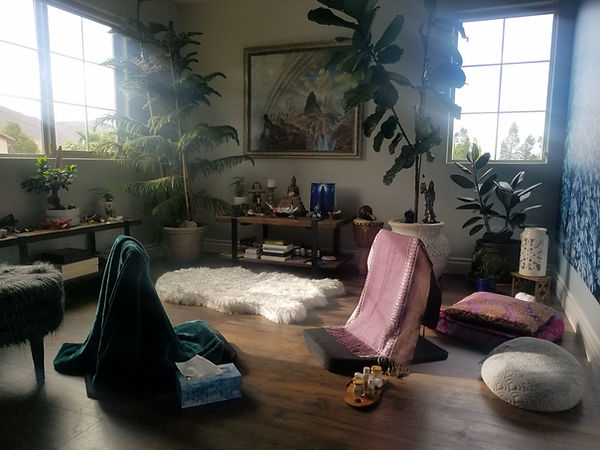
If you are interested in a private, couples, or group ceremony, please feel free to reach out using the form below.
updates & invites
Sign up for occasional e-mail updates and invites to open events.
© Copyrighted 2026 by Jaclyn Costello & Sanyasi LLC • 3249 Grayson Lake Court • Las Vegas, Nevada • 702.619.6219
Home • Couples Counseling • Existential Inquiry & Spiritual Thought • Sound & Ceremony • Yoga Nidra Meditations • Leadership & Presence
Shamanic Ceremonies • Hapé Ceremonies • Professor Page • Testimonials • Literary Speculative Fiction Site